Header Image - The Joshua Tree Genome Project

Yearly Archives

4 Articles

How association genetics can find genes that help Joshua trees beat the heat

by JTGP Admin 0 Comments

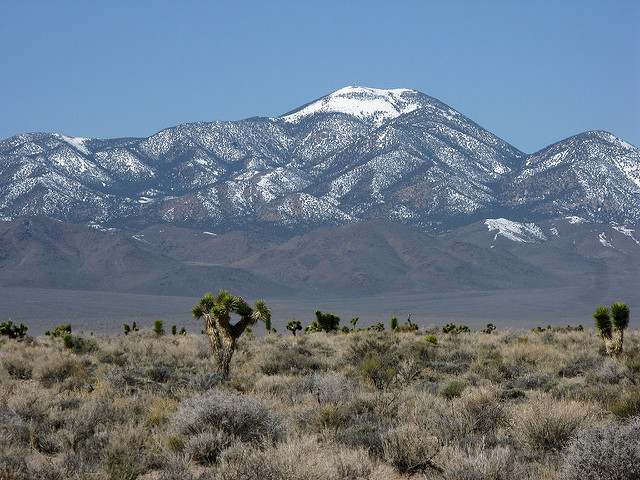
Joshua trees in Tikaboo Valley, Nevada (jby)

This post is by JTGP collaborator Jeremy Yoder, an Assistant Professor in the Department of Biology at California State University, Northridge, who studies ecological and evolutionary genetics.

Since we first launched the Joshua Tree Genome Project, we’ve told you that one big reason we want to sequence a Joshua tree genome is to find genes that are important for adaptation to climate, which could help us makes sure that Joshua trees survive and thrive in a climate-changed future. But we haven’t discussed in detail how we’ll find those climate-adapted genes. The key to that part of the project is association genetics, a method for sifting through the genome to find the parts that contribute to traits we care about.
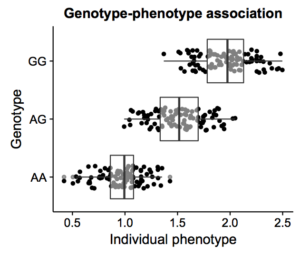
Figure 1. An example of a “candidate gene” experiment testing whether different diploid genotypes are associated with different trait values, or phenotypes. Points are the phenotypes of individual trees, grouped by their diploid genotypes at a candidate gene; overlaid box plots show that trees with different genotypes differ strongly in their phenotypes. (jby)

To understand how association genetics works, first consider a case in which we already know of a gene that might be important for a particular Joshua tree trait, like height or flower shape or physiological performance — or even just growing in places that are hotter or cooler. To figure out whether different variants in the sequence of our “candidate gene” are related to differences in the trait, we could measure the trait in many trees and then sequence that gene in all of those trees. We would test the hypothesis that the gene shapes the trait by comparing the trait values of trees carrying different variants of the gene sequence. Figure 1 gives an example of what this might look like in a hypothetical case, with tree phenotypes plotted against diploid genotypes at our candidate gene — “homozygous” trees carrying two copies of the G variant have higher phenotype values than homozygous trees carrying two copies of the A variant, and “heterozygous” trees with one copy of each have intermediate phenotypes. In this case, we’d probably conclude that the candidate gene has some effect on the phenotype we decided to measure, because different variants of the gene are associated with significantly different phenotype values.

0 views

Plant physiology, the key to understanding how Joshua trees could adapt to a warming world

Karolina Heyduk is a postdoctoral researcher at the University of Georgia, and a co-PI on the Joshua Tree Genome Project. Karolina studies comparative genomics and the physiology of photosynthesis (Karolina Heyduck)

This is a post by JTGP collaborator Karolina Heyduck, a postdoctoral researcher at the University of Georgia.

Our Joshua tree proposal has been submitted to the National Science Foundation! Now we wait to hear if we’re granted to green light to study sources of adaptation in these remarkable desert species.

So what does “adaptation” mean anyway?

Adaptation refers to the process by which species over time acquire traits that allow them to succeed in a given habitat. A habitat includes both biotic elements – herbivores, pollinators, and pathogens – as well as abiotic phenomena like water availability, nutrients, light intensity, and temperature. Our research team is interested in both aspects. We suspect both pollinators and environment (temperature and water availability) are playing a role in Joshua tree speciation and adaptation, but we hope to test this with help from the NSF. Plant species that have become especially adapted to their environment didn’t arise in a single generation; instead, over many years, plants have passed down traits to their offspring that allowed these species to survive and thrive in tough conditions. However, when these abiotic environments change quickly – for example, due to climate change – plants may not be able to adapt fast enough, especially if they are long-lived with many years between generations.

For Joshua tree, which can live over 100 years, adapting to their changing climate will be critical to their survival. Joshua trees are already showing signs of trouble (check out this National Geographic article on them), and the Mojave is only expected to become warmer, forcing Joshua trees to either adapt or die. Currently Joshua trees are found across both high elevation (cooler) and lower elevation (warmer habitats). In both of those elevational levels, we also find Joshua trees in drier and wetter habitats. We might hypothesize that those Joshua trees already found in the hottest and driest habitats might survive best in the future, but we simply do not know. One big goal of our NSF grant will be to screen populations from different habitat types for traits that will help them succeed in the changing Mojave. But how do we do that?

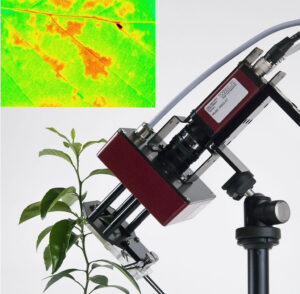
We will measure chlorophyll fluorescence with a fluorometer to determine photosynthetic efficiency and overall plant stress. (Wikimedia Commons: Felipe Jo)

Our first step will be to collect seeds from different populations across both high/low elevations and with varying degrees of rainfall. We will grow these seedlings and plant them in gardens across the Mojave desert. Once they stabilize, we begin screening them for a long list of characteristics relating to water use efficiency and photosynthesis – two huge traits when it comes to desert survival. Water use efficiency refers to how much water a plant loses for every molecule of CO2 is gains. Plants take in CO2 through their open stomata, tiny pores on the surface of the leaf, but stomata also allow water vapor to escape from the leaves. This loss of water to the atmosphere is important for plants to pull water from the soil, forming a suction force like when you drink from a straw, but too much water loss in the desert can be deadly. Plants can minimize water loss by closing stomata, but this must be balanced by the need to take in atmospheric CO2 for sugar production. Photosynthesis is also important for plant survival, but can be impaired by extreme temperatures and a lack of water (Figure 1).

Measuring these traits will take us a while, and can only be done with the help of both undergraduate students and citizen scientists. Once we’re done measuring our traits of interest, we can begin to determine which Joshua tree populations are most flexible – and therefore might be the quickest to adapt – to changing environmental conditions. Understanding how Joshua tree physiology interacts with their habitat is critical for our understanding of how to help this magnificent species persist into the future

0 views

By Invitation Only: The Next Step in Funding the Joshua Tree Genome Project

Hard at work on the full proposal. (CIS)

Back in January we wrote to you about preparing a proposal for the National Science Foundation. Now, we have some encouraging news to share.

Don’t break out the champagne yet though.

Last month we received the good news that our proposal had been ‘invited for a full proposal’.

As research funding has become more and more competitive, the National Science Foundation has turned to using ‘preliminary proposal’ system. Each January scientists from around the country put together short summaries of their latest and greatest research ideas. From the hundreds of preliminary proposals they receive, about eight dozen (approximately 25%) will be invited to submit a full proposal.

And (drum roll, please!) our proposal was one of the lucky ones invited to prepare a longer form description of our research proposal. So, while the rest of you are out enjoying the summer sun (or hiding from triple digit heat if you live in the Mojave), here at the Joshua tree genome project we’ve been hard at work trying to make the best possible case for our work. In a little less than a week we will send off our full proposal. And then we will wait …

We probably won’t hear a final funding decision until December at the earliest, and statistically, our chances are slim. But, at the moment, our thoughts are occupied with all the things that we will do if we were funded.

Here is a partial list of what we have in mind:

  • Completing, assembling, and annotating the full Joshua tree genome
  • Surveying genetic diversity across the entire range of the Joshua tree
  • Common garden experiments to identify genes involved in climate adaptation
  • An expanded citizen science program with Cal Native Plants
  • Public Lectures at the Desert Institute
  • Research internships for underrepresented minority students
  • Outreach to public school teachers in southern California

It’s a long and ambitious list. We hope that it’s enough to make our work stand out. Wish us luck!

0 views

It’s grant proposal season

(CIS)

It was a rainy winter in the Mojave, and it was mighty quiet around the ol’ Joshua Tree Genome Project Page.

But we didn’t just huddle up around the fire.

January means grant proposal deadlines at the National Science Foundation, so while the yucca moths were underground this winter, we were hard at work trying to find funding for the next phase of this project. The generous support we’ve received from donations at Experiment.com and from The Living Desert Zoo, we’ve made huge progress towards assembling the Joshua Tree Genome. However, completing the next stage in the project – identifying the genes involved in adaptation to climate change – is going to be expensive. So, we’re looking to NSF to help us make it happen. Thanks in large part to the work we’ve been able to do so far, that proposal we wrote back in January was interesting enough to NSF for us to be invited to the next round of consideration — look for an update on that part of the process soon.

Research dollars are getting harder and harder to come by as federal spending for basic research has stagnated. So, the competition is fierce, and winning the funding game means we’ve gotta hit it out of the park. I hope what we’ve put together for tomorrow’s deadline is up to the task.

To learn more about the value of basic research check out this great story from the PBS News Hour. It’s an essay by Sheila Patek, a biologist at Duke University who studies, among other things, the biomechanics of mantis shrimp, which use their flimsy forelimbs to punch through tough snail shells. Patek’s work can seem frivolous, but it might also lead to biologically-inspired designs for stronger materials. She says

The nature of discovery is that it is impossible to anticipate what you will find. That is discovery. Discovery-based research is most fruitful when new knowledge is sought for its own sake.

If you agree, maybe phone a friend in Washington to tell her about it?

0 views